8.20.2014

Spoiler Alert: How to Talk about Geekery Online

(photo credit)

No, not that Spoiler.
I’m a pretty busy person.  Between school and work, I have very little free time to spend playing games, watching television, or going to the movies.  As a result, I don’t play through games as fast as most people, nor do I always catch shows or films when they are first aired or released.  Since I spend a lot of my time on the internet due to the nature of my work, I am in constant danger of the dreaded Spoiler.

Spoilers are pervasive in internet culture.  They’re especially frequent in social media, where individuals will live blog or tweet shows, chronicling what happens as it happens. It’s a completely natural reaction to things—as a fan, I often feel the need to talk to someone about something on a show immediately.  While you can find spoilers on just about everything, most of them are just a natural part of the excitement and enthusiasm of fandom.

This is not meant to excuse spoilers, but to make us better understand why they happen.  Sometimes people post spoilers out of malevolence, but that’s extremely rare.  Instead, we can prevent spoilers and being spoiled through common courtesy and due diligence. 

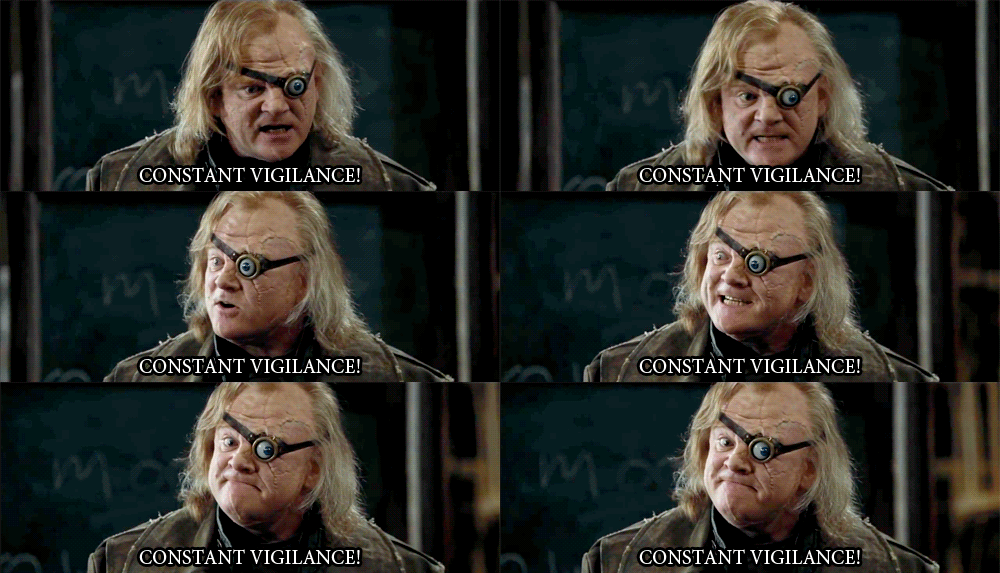
And this.
If we take responsibility on both sides, and think before we click or post, we can win the battle against spoilers.  Here's some advice to avoid posting spoilers, and avoid reading them.  It takes both sides!

To Keep From Spoiling:

  • Never talk in specifics. You can post something like "Game of Thrones was unbelievable tonight!", but stay away from statements like "I'm so glad they finally killed him! I hated that character!" Definitely don't get any more specific than that, either.
  • If you want to talk about an event, text or call a friend who watches the show (or watch it with your friends). Don't throw a statement out into the ether of the internet that could spoil things for others.
  • If you're posting a review and want to talk about something that happened in the show/movie/game, then make sure you warn readers abut spoilers. You can also put a spoiler tag over the part of the article that would give things away.
  • Start a conversation with sentences like "Have you watched the last episode of Sherlock?" If they say no, then you can't accidentally spoil them. 
  • Be courteous to the people around you, and think before you say things.  I've had to stop myself on the verge of giving spoilers for a new show or movie without even thinking about it.  Don't be a jerk, and don't be that guy.

To Keep From Being Spoiled:

  • Be careful on social media.  Don't go on sites that are notorious for spoilers (i.e. Tumblr, Twitter), and make sure that you don't look under any show-specific hashtags.
  • Avoid news articles or reviews.  They're likely to talk about major plot events -- the things that everyone is talking about at the water cooler (figuratively speaking) -- so you may end up reading something you don't want to read.
  • Catch up quickly. There's a statute of limitations for internet spoilers that spans about one week. After that you can be disappointed, but you shouldn't be mad about being spoiled. 
  • Let people know you're not caught up. Especially if you are consuming older media for the first time, you can be accidentally spoiled! Mention at the start of the conversation where you are at so others can avoid spoilers.

Do you think that these steps could work to prevent spoilers? Do you have any other suggestions, or things you disagree with? Leave your thoughts in the comments!


As a card-carrying member of the Justice League, honorary Star Fleet ensign, and a Ph.D student in political science, Amanda doesn't have much spare time on her hands. But when she does, she spends it gaming, nerdcrafting, marathoning shows on Netflix, debating Tolkien online, sewing costumes for cosplay, and writing on Geekphoria.net.
Find Amanda? Twitter ★ Tumblr ★ Blog

7.09.2014

Mean Geeks: Bullying Between Nerds

(photo credit)

"It's not about you, it's about them. They're hiding their own insecurities by making you feel bad about yourself." 

Anyone who's been bullied has heard something like this, usually in an attempt to cheer you up or make your feel better. It's practically become an adage that often pops up when people talk about bullying. There's even a video where Wil Wheaton, nerd royalty, promotes this point of view.


While I was growing up, I never bought into this idea. Even now, I frequently have trouble accepting it. Do people feel the need to pick out an individual and constantly berate them because they feel sad? Maybe. But does it hold true for everyone? Is bullying just one persons's attempt to make themselves feel like they're better than at least one other person?

I bring this up not to try to make sense of school-yard bullying - or similar scenarios - but to address the recent rise of inter-geek bullying.

Many of us geeks have a history of being bullied, but it seems like some of us have embraced the opportunity to become the bully. We see it everywhere, but it's definitely most prominent online. Some of us are chastised for being "fake" geeks, particularly women. Others are criticized for liking the "wrong" series or characters. Some people are deemed "not geeky enough" because they like a movie more than the books or comics it's based on (or - God forbid - haven't even read the source material). 

These days, it seems like more names and insults are being flung from geek to geek than come from outside the geek subculture. Why do some of us feel the need to put others down? I think this is where the type of phenomenon Wil Wheaton discusses really rears its head. Geeks who have until now been bullied for their hobbies are able to set themselves up as "better" than others who are interested in the same thing; they're able to increase their own self-worth at the expense of others. Sure, a lot of this existed before now, but the internet has made it much more visible, if not more common. 

So here's the big question that I'm opening up to dialogue: How should we respond to bullying in geekdom? Do we ignore the mean geeks? Try to have a rational discussion? Chastise or shame bullies? Punch them in the face? (Please don't punch them in the face.) Do we try to be non-confrontational, or should we try to make the geek world friendlier and more inclusive?


As a card-carrying member of the Justice League, honorary Star Fleet ensign, and a Ph.D student in political science, Amanda doesn't have much spare time on her hands. But when she does, she spends it gaming, nerdcrafting, marathoning shows on Netflix, debating Tolkien online, sewing costumes for cosplay, and writing on Geekphoria.net.
Find Amanda? Twitter ★ Tumblr ★ Blog