Showing posts with label amanda. Show all posts

8.20.2014

Spoiler Alert: How to Talk about Geekery Online

(photo credit)

No, not that Spoiler.
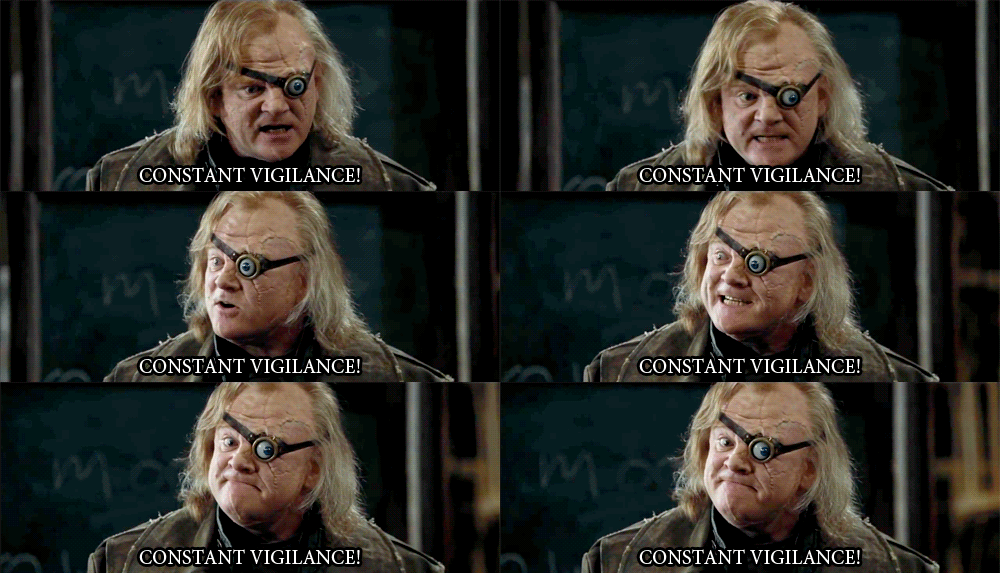
I’m a pretty busy person.  Between school and work, I have very little free time to spend playing games, watching television, or going to the movies.  As a result, I don’t play through games as fast as most people, nor do I always catch shows or films when they are first aired or released.  Since I spend a lot of my time on the internet due to the nature of my work, I am in constant danger of the dreaded Spoiler.

Spoilers are pervasive in internet culture.  They’re especially frequent in social media, where individuals will live blog or tweet shows, chronicling what happens as it happens. It’s a completely natural reaction to things—as a fan, I often feel the need to talk to someone about something on a show immediately.  While you can find spoilers on just about everything, most of them are just a natural part of the excitement and enthusiasm of fandom.

This is not meant to excuse spoilers, but to make us better understand why they happen.  Sometimes people post spoilers out of malevolence, but that’s extremely rare.  Instead, we can prevent spoilers and being spoiled through common courtesy and due diligence. 

And this.
If we take responsibility on both sides, and think before we click or post, we can win the battle against spoilers.  Here's some advice to avoid posting spoilers, and avoid reading them.  It takes both sides!

To Keep From Spoiling:

  • Never talk in specifics. You can post something like "Game of Thrones was unbelievable tonight!", but stay away from statements like "I'm so glad they finally killed him! I hated that character!" Definitely don't get any more specific than that, either.
  • If you want to talk about an event, text or call a friend who watches the show (or watch it with your friends). Don't throw a statement out into the ether of the internet that could spoil things for others.
  • If you're posting a review and want to talk about something that happened in the show/movie/game, then make sure you warn readers abut spoilers. You can also put a spoiler tag over the part of the article that would give things away.
  • Start a conversation with sentences like "Have you watched the last episode of Sherlock?" If they say no, then you can't accidentally spoil them. 
  • Be courteous to the people around you, and think before you say things.  I've had to stop myself on the verge of giving spoilers for a new show or movie without even thinking about it.  Don't be a jerk, and don't be that guy.

To Keep From Being Spoiled:

  • Be careful on social media.  Don't go on sites that are notorious for spoilers (i.e. Tumblr, Twitter), and make sure that you don't look under any show-specific hashtags.
  • Avoid news articles or reviews.  They're likely to talk about major plot events -- the things that everyone is talking about at the water cooler (figuratively speaking) -- so you may end up reading something you don't want to read.
  • Catch up quickly. There's a statute of limitations for internet spoilers that spans about one week. After that you can be disappointed, but you shouldn't be mad about being spoiled. 
  • Let people know you're not caught up. Especially if you are consuming older media for the first time, you can be accidentally spoiled! Mention at the start of the conversation where you are at so others can avoid spoilers.

Do you think that these steps could work to prevent spoilers? Do you have any other suggestions, or things you disagree with? Leave your thoughts in the comments!


As a card-carrying member of the Justice League, honorary Star Fleet ensign, and a Ph.D student in political science, Amanda doesn't have much spare time on her hands. But when she does, she spends it gaming, nerdcrafting, marathoning shows on Netflix, debating Tolkien online, sewing costumes for cosplay, and writing on Geekphoria.net.
Find Amanda? Twitter ★ Tumblr ★ Blog

7.09.2014

Mean Geeks: Bullying Between Nerds

(photo credit)

"It's not about you, it's about them. They're hiding their own insecurities by making you feel bad about yourself." 

Anyone who's been bullied has heard something like this, usually in an attempt to cheer you up or make your feel better. It's practically become an adage that often pops up when people talk about bullying. There's even a video where Wil Wheaton, nerd royalty, promotes this point of view.


While I was growing up, I never bought into this idea. Even now, I frequently have trouble accepting it. Do people feel the need to pick out an individual and constantly berate them because they feel sad? Maybe. But does it hold true for everyone? Is bullying just one persons's attempt to make themselves feel like they're better than at least one other person?

I bring this up not to try to make sense of school-yard bullying - or similar scenarios - but to address the recent rise of inter-geek bullying.

Many of us geeks have a history of being bullied, but it seems like some of us have embraced the opportunity to become the bully. We see it everywhere, but it's definitely most prominent online. Some of us are chastised for being "fake" geeks, particularly women. Others are criticized for liking the "wrong" series or characters. Some people are deemed "not geeky enough" because they like a movie more than the books or comics it's based on (or - God forbid - haven't even read the source material). 

These days, it seems like more names and insults are being flung from geek to geek than come from outside the geek subculture. Why do some of us feel the need to put others down? I think this is where the type of phenomenon Wil Wheaton discusses really rears its head. Geeks who have until now been bullied for their hobbies are able to set themselves up as "better" than others who are interested in the same thing; they're able to increase their own self-worth at the expense of others. Sure, a lot of this existed before now, but the internet has made it much more visible, if not more common. 

So here's the big question that I'm opening up to dialogue: How should we respond to bullying in geekdom? Do we ignore the mean geeks? Try to have a rational discussion? Chastise or shame bullies? Punch them in the face? (Please don't punch them in the face.) Do we try to be non-confrontational, or should we try to make the geek world friendlier and more inclusive?


As a card-carrying member of the Justice League, honorary Star Fleet ensign, and a Ph.D student in political science, Amanda doesn't have much spare time on her hands. But when she does, she spends it gaming, nerdcrafting, marathoning shows on Netflix, debating Tolkien online, sewing costumes for cosplay, and writing on Geekphoria.net.
Find Amanda? Twitter ★ Tumblr ★ Blog

6.19.2014

You Can't Read That: Book Shaming and Nerd Culture

(photo credit)

What was the last book that you couldn’t put down? Personally, I’m making my way through The Lunar Chronicles by Marissa Meyer, and I haven’t been able to put them down. The books are fun re-imaginings of fairy tales amidst political intrigue, plague, and the threat of war. They’re also very much Young Adult (or YA) fiction.
If you’ve read the article by Ruth Graham that’s been making its way around the internet (or any of the billion responses), you’ll know she thinks I should be ashamed to read YA fiction. Graham disparages YA for its “pleasurable” reads, its reliance on the teenage perspective, its frequently satisfying endings (where has she been that she thinks this still happens?), and its ultimate failure to be “literary." As someone who is now in my late-twenties (shudder), I shouldn’t be entertained or entranced by anything written from the perspective of a teenager.
Graham argues that I (alongside teenagers and other literarily stunted adults) should aspire to more “grown-up” reading. YA novels, in her perspective, are unable to teach us anything about life. But let’s ignore the argument over whether YA is valuable, and instead focus on the core of her argument: it is not worthwhile to read for any reason other than the pursuit of sophistication. And, Graham asserts, YA fiction is supremely unsophisticated.

Well, I say screw that. We have few enough individuals in this country who read for pleasure anymore—and shaming people for the type of book they choose to pick up isn’t helping the problem. There are thousands upon thousands of legitimate reasons to read Young Adult fiction, but by far the most important is this:

Because you want to.

So, in the spirit of fighting against this type of bigotry and shaming, here is my list of YA books and series that you should definitely pick up this summer! Some of these books share “deep” stories that rival many of the adult fiction that Graham lauded, but some are definitely more fun romps in sci-fi and fantasy. All, though, deserve a read!


Note: The lines of “Young Adult” literature are frequently blurry, but all these books are usually, if not always, considered YA. 


(Superheroesque gets a small kickback if you purchase through this link. Thanks for your support!)

Do you have any YA recommendations? Leave them in the comments!


The short version of this blog post basically enforces a truth that I hold dear—different people like to nerd out over different things, and it’s never brave or cool or responsible to condemn people for enjoying things that you may not personally enjoy. Let’s ignore the Slate author and talk about ourselves for a moment. We’ve built this nerdy community, and within it we should support each other and our passions. As Wil Wheaton said, “Being a nerd not about what you love, it’s about how you love it.” I won’t be shamed—you can’t take my books from me.


As a card-carrying member of the Justice League, honorary Star Fleet ensign, and a Ph.D student in political science, Amanda doesn't have much spare time on her hands. But when she does, she spends it gaming, nerdcrafting, marathoning shows on Netflix, debating Tolkien online, sewing costumes for cosplay, and writing on Geekphoria.net.
Find Amanda? Twitter ★ Tumblr ★ Blog

5.13.2014

What Alanna of Trebond Taught Me about Perseverance

I’ve always been kind of on the lazy side. I think it probably has to do with the fact that I was a really bright child, and picked up things very quickly (if only that had stuck with me as I aged). Unfortunately, I became way too used to this, and often fell into the trap of being way too lazy. If I wasn’t great at something right away, my first instinct was always to give up and try something else. I played eight different sports as a kid and constantly tried and discarded hobbies, looking for something I could be great at without really trying.

It wasn’t until I got a little older that I was actually able to learn a lesson from one of my favorite books: Alanna: The First Adventure, by Tamora Pierce. As the title indicates, the book follows the young Alanna of Trebond. Alanna and her twin brother switch places, and Alanna takes his spot and starts on the journey to become a knight (her brother wanted to be a sorcerer). Alanna had always been something of a tomboy, and was always more interested in fighting and weaponry than anything about being a lady. Knighthood was her dream.

However, knight training wasn’t as glamorous as she had expected, and within the first week she storms back into her rooms and tells her man-at-arms to pack up. She was ready to throw in the towel because the training was a lot more difficult than she had expected, and she wasn’t as good at it as she wanted to be at the beginning. This struck a chord with me—I had been there so many times before. After an honest talk with her man-at-arms, though, Alanna realizes how immature she had sounded. She wanted this. She wanted to be a knight. And the things that you want frequently require you to work for them.

So how do you keep yourself from throwing in the towel? Just follow these few pieces of advice—things that I learned from Alanna.

Don't give up. The best is yet to come!

1.  Make Time for Yourself


Liz posted a great video on the importance of schedulingyour self-love, and I don’t have much to add on that front. Spending time on yourself, though, can be an important part of perseverance! It definitely can help when the going gets rough. Maybe you began a project extremely motivated, but you’ve become more discouraged as time has gone by. Take a break to do something that you love! It will prevent you from burning out.

2.  Confide in a Friend


Everyone has moments when they’re not sure that they’re on the right track, or when they’re ready to give up. At this point, it’s really helpful to talk things out. You can find out if your goals have really changed, or if you’re actually just discouraged or frustrated. It took a talk with Coram to make Alanna realize that she was just running away from her problems. She still wanted to be a knight, but she hadn’t expected it to be such a challenge. Sometimes, another perspective can help you overcome a problem.

3.  Envision the Payoff


There was a reason that you took up that hobby, started that business, or entered that program. What was it? Did you want to be able to knit your new niece a baby blanket? Do you envision having a table in a con’s Artist’s Alley? Does your dream job require a new degree? When you’re discouraged, remember these goals and remember why you started toward them in the first place.


Alanna went on to become one of the greatest knights in all Tortall—and the only female knight. Maybe your goals aren’t that lofty, but they’re always worth pursuing! So next time you find yourself becoming discouraged, do what Alanna did and follow these pieces of advice. They will help you to reach your goals!


As a card-carrying member of the Justice League, honorary Star Fleet ensign, and a Ph.D student in political science, Amanda doesn't have much spare time on her hands. But when she does, she spends it gaming, nerdcrafting, marathoning shows on Netflix, debating Tolkien online, sewing costumes for cosplay, and writing on Geekphoria.net.
Find Amanda? Twitter ★ Tumblr ★ Blog

4.25.2014

Taking Charge: What Star Trek Taught Me About Intelligence


Sometime during my high school years, I learned that some people don’t think that it’s alright for women to be intelligent. They think that the females of the species should naturally be less intelligent than the males and that, if one happens not to be, she is some sort of anomaly worthy of marvel or resentment. In order to be “attractive,” a woman shouldn’t be more intelligent than her partner—or any man, for that sake. Women should not speak in ways that show off intelligence. If, in fact, a woman’s cranium contained serious power, she should do her best to hide this from the people around her. This was necessary, lest she accidentally offend someone by showing them the size of her upper lobes.

 I’m being somewhat facetious here, mostly because I was lucky enough to grow up in a household where the intelligence of women was celebrated. My own mother is one of the most brilliant people I have ever met, but there was another significant influence on why I never had the misfortune of believing that “Girls shouldn’t be smart” while I was growing up—Star Trek: Voyager.

I suppose that I was also lucky in this case, because Voyager aired during an important time during my youth. The show premiered when I was six years old, and ended when I was fourteen (there’s some weird things with premiere and finale dates and birthdays here). And every week of these seven seasons, this show played in my living room.

I was fascinated by Voyager—even though it is one of the series that earns the most disdain from fanboys. The captain of the ship was a woman. The chief engineer was also a woman. If you ignore the Vulcan (because really, that’s unfair), I would say that without a doubt the three most intelligent individuals on that ship were Captain Janeway, B’Elanna Torres, and Seven of Nine. They were certainly the most intelligent of the primary characters. Janeway was a science officer before she was—in my opinion—an excellent captain. Torres is shown to be an engineering genius. We’re told that she was one of the brightest engineering students in Star Fleet history, and there’s an episode where machines almost worship her mechanical prowess. Finally, Seven of Nine came from a family where her mother was her father’s intellectual equal—and intelligence is obviously hereditary in this family. Seven frequently shows a technological prowess that isn’t only due to her Borg past.

Whenever a conflict in the series required a solution that requires brains over brawn, the answer was usually provided by one of these women. But Janeway, Torres and Seven didn’t just show me that women can be intelligent: they showed a little girl that women can be just as intelligent as men, and that it was natural for men to look to women for answers. That sort of dynamic is rare in the media—one of the few examples we all should be familiar with is that between Hermione, Harry, and Ron—but it is an invaluable type of interaction for a young girl to be exposed to.


The women of Star Trek: Voyager showed me that women were just as strong as men— and they can be just as, if not more, intelligent than their male counterparts. Women could be the ones making scientific breakthroughs, the ones to solve the puzzles and save the day, instead of the ones tasked with standing off to the side and looking impressed. I personally think that every young girl should watch and learn from Captain Janeway, Chief Engineer B’Elanna Torres, and Seven of Nine.

As a card-carrying member of the Justice League, honorary Star Fleet ensign, and a Ph.D student in political science, Amanda doesn't have much spare time on her hands. But when she does, she spends it gaming, nerdcrafting, marathoning shows on Netflix, debating Tolkien online, sewing costumes for cosplay, and writing on Geekphoria.net.
Find Amanda? Twitter ★ Tumblr ★ Blog

3.05.2014

How I Learned to Love the Geek

I’ve been a geek since before I knew what a geek was. I was definitely a geek before it was acceptable to be a geek. I don’t remember a point in my life before Star Trek, Star Wars, Highlander, Lord of the Rings, or any form of fantasy and sci-fi. Pretty much anything I read was fantasy, sci-fi, or horror (which I, personally, find highly related to the other two). I even threw myself into my more “typical” adolescent girl interests—horses, for example—with a geeky fervor. You know what I’m talking about—the drive to find out everything about a subject, to surround yourself with the things you love, and to develop a passionate relationship with your interests.

I’m tempted to list out everything that made me into a young geek, but I know that’s not necessary. It ultimately doesn’t matter if you were into comic books, science fiction TV shows, or writing fanfiction—if you’re a young nerd, it tends to show through very easily. It reminds me of part of my favorite quote from John Green—he says that nerds are ultimately just “too enthusiastic about the miracle of human consciousness.” This enthusiasm often can’t be contained. It’s similar to the look someone gets when they talk about someone they love—except for nerds, it comes about when we talk about Harry Potter, World of Warcraft, or Battlestar Gallactica. There shouldn’t be anything wrong with unbridled enthusiasm, and there’s nothing wrong with letting it show.


Unless, apparently, your enthusiasm makes you appear “different.” In my case, I already stood out in my small-town Catholic school. One of the terms that best describes my looks is “ethnically ambiguous” and this was even more apparent when I was young. If you coupled the fact that I looked decidedly “other” with the fact that I would always have my nose stuck in a book adorned with knights in shining armor—therefore acting obviously “other”—it was a recipe for disaster.

Without getting into too many details, my family eventually moved to a new town due to the bullying, but it really didn’t stop. I became a little less withdrawn than I was at my old school, but I had learned to treat my geekiness like a horrific disease—it was as if I felt like I was plagued with a disease that I had to keep secret from everyone else. I made a few friends throughout middle school, high school, and my undergraduate career who liked the same things I did, and that was nice. But I still felt the need to restrain my inner geek. I wrote fanfiction in secret. I hid comic books in my bedroom. If anyone made a joke at the expense of another geek, I would awkwardly chuckle but wish I could just disappear.


The stereotypical male nerd is annoyed by the role the internet played in making geekdom an acceptable subculture. I, on the other hand, can’t thank it enough. It hasn’t changed life dramatically—people still look at my strangely when I walk around in my Star Trek hoodie, for example—but it has given me a sense of belonging. When I was younger I felt like an outsider, like there was something different about me that made me love things that no one else cared about—and that they would make fun of me for loving. I was able to meet other people through the internet who did enjoy these things, though, and it made me comfortable with myself again. It let me once again embrace the enthusiasm that defines the geek community. Another helpful thing was going to graduate school—nerds purposefully put themselves into this environment, and many people enjoy the same things I do.

These communities allowed me to become comfortable enough with myself to the geek inside me roam free once more. And I have to tell you—I’m much happier with life now that I don’t care about a discouraging look or a snide comment about my nerdy hobbies and interests. If anything like that does happen, I can turn to the internet community and people there will make me feel better and confident again. I’m only sad that it took me this long to embrace the geek again. I really missed out on collecting some badass action figures over the last twenty years.

As a card-carrying member of the Justice League, honorary Star Fleet ensign, and a Ph.D student in political science, Amanda doesn't have much spare time on her hands. But when she does, she spends it gaming, nerdcrafting, marathoning shows on Netflix, debating Tolkien online, sewing costumes for cosplay, and writing on Geekphoria.net.
Find Amanda? Twitter ★ Tumblr ★ Blog