Showing posts with label geek identity. Show all posts

8.28.2014

A Girl Walks into a Comic Book Store...

When I was fourteen years old, I discovered a tier of geek-dom to which I did not yet belong. Given that I was the girl who re-watched the original Star Wars trilogy with her family every Christmas, this came as something of a nasty shock.

Comic Books
(photo)
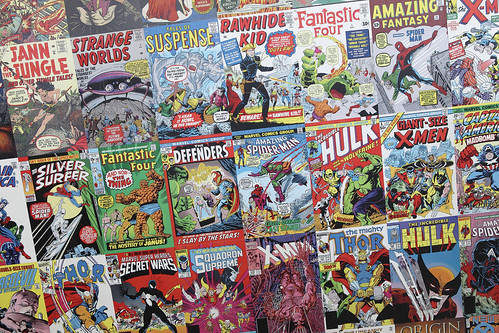
The impromptu trip to DNA Comics was the suggestion of a boy on our first and last date. Said boy had been pleased to hear that I enjoyed Archie, Beetle Bailey, and a wide variety of manga. As I understood it at the time, those were the two bottom rungs of the comic book hierarchy, largely because they were the easily accessible. Superhero comics, by comparison, were in a league of their own. With most superhero comics spanning decades of history, they weren’t easy to delve into, which was perhaps why, until then, I had never tried. But there I was, in the middle of a shop that specialized in the very genre I’d always feared to touch. While my date chatted with the shopkeepers, I stared in awe at the full-color, 20-page comics that liked the walls and filled box upon box of in the center of the store, feeling like an idiot child among her elders.

 I’m sure you already suspect what might have happened next. The shopkeepers would snicker about the ignorant girl in their midst, make a few jokes, then wait patiently for my date to buy his book and leave. I would shuffle out, humiliated, and decide it was better not to return. That’s certainly the stereotype that has formed about a girl’s experience in a comic book store. Which is exactly why I will be forever grateful that that’s not what happened. 

The shopkeepers were amused, perhaps even a little delighted by someone who clearly knew little about American comics. It was an opportunity to mold an impressionable young nerd, to steer her away from bad storylines and set her on the path to nerdy enlightenment. While one shopkeeper chatted with my date, the other led me around the store, gently asking me what I was looking for.

“Who’s your favorite mutant? Oh, you like Nightcrawler?” he said. “I think we’ve got a few back-issues."

“What about something with really nice art?” I asked timidly. The shopkeeper adjusted his glasses, scrolling through the unseen rolodex of comics in his mind.

Fathom is good, but I don’t think we have issue one. I bet you’d like Meridian. It’s pretty cool. We’ve got loads in the ten cent bin.”
Comics
(photo)


I returned from my date with no goodnight kiss and no budding romance, but I did have a bag stuffed with discount comics. Over the next few months, I visited DNA Comics each time I hit the mall. In that time, I didn’t become particularly comics-savvy, but I assume I became “that- cute-high-school-girl-who-likes-the-cheap-comics”, because the shopkeepers always smiled when I entered and even gave me discounts on the already dirt-cheap comics.

A year later, DNA comics closed down and, with it, my budding education in Western comics. All my peers still favored manga so, naturally, I followed suit. But that dim interest remained. So, when a friend introduced me to a new comic book store years later, I had to try it out.

The Fat Ogre wasn’t the sort of place I expected to welcome me. It was largely a tabletop gaming store, and gamers had a reputation for shunning women from their territory. Even though I went with a friend who loved the staff enough to bring them cookies, I crept in like a green warrior seconds away from her first battle. I donned brashness and overconfidence like armor, determined not to be mocked. No. I’d be the other woman. The one so dolled up, so aloof and outwardly confident, nobody would dare approach me much less tease me. After all, I was no longer that cute little fourteen-year-old. The leeway DNA Comics had given me might not extend to the Fat Ogre.

The store was twice the size of DNA comics, with double the trade paperbacks available and, subsequently, double the clientele. What the staff thought of the tense, uncomfortable girl who wandered into their midst, I have no idea. They were far too busy with their regular clientele: the tabletop gamers who overtook half the store. But I bought a Firefly comic and a plastic Green Lantern ring without incident, so they must not have been too bothered. In my subsequent visits, the Fat Ogre smoothed my hackles as a gentle hand calms a wild animal. When I took an interest in Squirrel Girl and they didn’t have comics featuring her, a friendly shopkeeper directed me to a similarly earnest young character, Nomad. When I journeyed in searching for Nightcrawler, Harley Quinn, or Hawkeye, someone was always happy to discuss the character with me. Heck, when I came in on Free Comic Book Day, the male and female staff greeted me and offered me extra swag to take to friends who couldn’t come in.

Big_Planet_CP_01
(photo)


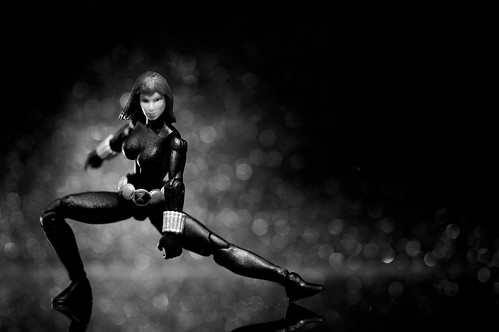
On one notable occasion, when I was still in college, I wandered in with a friend discussing my current history major and how it was changing my perspective on comics. In the same breath, I mentioned my growing interest in Black Widow, as The Avengers was due to come out in a few months. As I contemplated buying the new comic Marvel had produced, one of the shopkeepers caught me.

“Oh no, you don’t want to read that if you’re not familiar with her,” he said, and led me to their trade hardback section. “Try this. Sting of the Black Widow. I’m afraid we only have it in hardback, but if you really want to know her history, this is what you want to read.”

It was easily the most expensive comic I’d bought to date, so it’s a testament to the trust I put in the Fat Ogre staff that I said “Okay!” and bought a hardcover trade compilation of comics for a character I hardly knew. While I was checking out, the shopkeeper laughed and told me about some of his favorite Black Widow moments. Like the time she showed up in the bed of blind Daredevil, or her remark at the funeral of Hercules.

“So then Black Widow says, ‘Yeah, he was a great lay’. And right then, every other female in the room nods and says ‘Oh yeah’. Like, all of them.”

What he said: Black Widow has some funny, sex-related situations and she’s not ashamed about them.

What he did not say: What a tramp!

By this point, I’d almost forgotten there even were guys who scorned women in comics, which was probably why the universe saw fit to remind me. Just as the shopkeeper launched into an explanation of who the comic version of Hercules was, a teenaged boy in a dark hoodie wandered up to the counter. He must have heard the story about the funeral, because he laughed and snorted.

"Slut."

Now, when I was 9, I’d been roughhousing with a boy on the playground. Well, I say roughhousing. Really, I was teasing and pestering him because, back then, I didn’t understand that what your brothers will put up with, a boy at school might not. The boy in question tried to shove me off and, in so doing, accidentally rammed his elbow hard into my stomach. The air hissed out between my teeth. I dropped to the ground, tears springing to my eyes as I struggled to breathe. Of course, the boy was instantly apologetic and when everyone made a big fuss about it, we reassured all of them that it wasn’t a fight. But after that day, I knew what it felt like to be rammed in the gut, and I stopped pestering him. 

Standing in the Fat Ogre, I felt like that teenager had just slugged me in the gut. I sputtered, to angry even to speak. The shopkeeper shot him a glare, but said nothing else. After all, half his store was packed with teenaged boys competing in gaming tournaments. He was used to it.

At last, I found my voice.

Marvel Knights.
(photo)
“Actually, Hercules is the one that slept with everyone,” I argued. “Tony Stark, too. Black Widow just-"

“She’s just a slut,” he guffawed. "Look at her. She's only there to have sex."

Then, with the swagger of an idiot, he sauntered out the store. I turned back to the shopkeeper, a sour taste in my mouth. He didn’t say anything as he sold me my book. I didn’t say anything as I shuffled out the door, feeling strangely off balance. For so long I’d assumed the stereotypes about comic book stores were wrong. I’d believed they were perpetually safe, tolerant places where we all met to escape a harsher, less forgiving world. It seemed that they, like any other community, could be infiltrated by the rude and close-minded.

Of course, one bad experience wasn’t enough to tarnish my love of a good comic book store. I moved to Austin and fell for ABC comics next, where I met with a similarly diverse and welcoming staff (“Oh man, if you’re interested in Winter Soldier you have to start with the original appearance. It’s hands down one of the best I’ve ever read.” “Hm, I’m not familiar with X-23, but so-and-so knows all about her.” “Well, we haven’t got the new Firefly trade, but our sidekick store does. Here are their hours. Wait until you read it!”). A life-sized Hulk and Silver Surfer guarded the back issues. Shelves stretched so high, the shopkeepers needed ladders to reach the tops. It seemed as though every comic ever printed was available in that monstrous store. From within that haven, it was hard to imagine that there was anyone on earth who didn’t want to read comics.

Of course, I’ve run into my fair share of bad comic book stores. There were run-down shacks with yellowing walls and grimy carpet, dusty stores with shopkeepers who fussed at you for flipping through a comic without buying it. When there were no specialty shops available, I bought my comics from Amazon and Half Price Books just like anyone else, but there’s nothing quite like the comfort of walking into one of my stores. It’s like coming home. But even home can sometimes feel unwelcome on the worst days.

Even now, I can’t help remembering that off-hand comment from an idiot boy, particularly when I hear the story of someone who’s felt unwanted in a store or a convention. The words hiss in my ear like a little shoulder devil with a hoodie and bad acne.
Universal Black Widow
(photo)
The first time it happened, it was with a woman I met at a science fiction convention. "One time, my boyfriend and I went into a store to buy some cards. We always played together. We actually met through gaming. The clerk asked if he let me win. We were both so shocked we just left without buying anything."

Slut.

Then there was the professional cosplayer. "The first time I walked into a comic book shop, totally scared and intimidated, the man behind the counter greeted my boyfriend, but not me. My boyfriend at the time asked where the gaming accessories are, and he pointed him in the right direction. I asked for help with comics, and he told me that there was a new Lady Gaga comic that had just come out. Condescendingly."

Just look at her.

And the sales woman. "I work at comic conventions. But every time I work I get asked if I'm a 'booth babe' and then they always seem astounded that I even know what the comics are about. Let alone be able to actually sell them something they might want to read. It usually leads them to take a picture of me saying I'm a 'rare breed'. Which is really just downright rude and I'm normally scowling for the picture."

She's only there to have sex. 

Even the computer programmer. "Guys get it too, though. Apparently I'm not 'geeky' enough because I only play Magic and don't fawn over comics."


I can feel the elbow in my gut every time a friend describes one of these experiences. How is this possible? How have I had such good luck when so many have felt marginalized and unwanted? What kind of a businessman knowingly alienates a potential demographic like that? Don’t they realize they’re stopping a fan before they can even start?

The theories about this sort of behavior are rampant. Some boil it down to basic sexism: some men in these communities can’t separate women from sex, and other women would rather renounce a newcomer than risk being labeled “fake”. But it happens to men, too. In this community, to be fake is to be a pariah. It is the spy exposed, the villain outed, the wolf in sheep’s clothing. Yet in all my years of attending conventions, visiting comic book shops, and attending clubs, I have never met a person who did not want to be exactly where they were. Who on earth would spend their precious time and money on comics, costumes, movies, and merchandise if they didn’t like the core subject? What sort of person could possibly think someone would?

Perhaps it’s a superiority complex. These individuals pride themselves on their vast knowledge, blaming their passion for comics or gaming for their poor social skills. As such, they take on the behavior of a cornered cat when their safe haven is suddenly invaded by newcomers with less knowledge and experience: people who must not be real nerds, geeks, or fans. The invaders must be cast out!

For all that I’ve been accepted, I suddenly find myself raising my guard when I enter a new store. Will I pass the test? Is my hair sufficiently frizzy, my glasses thick enough? Should I have worn that geeky Star Wars shirt instead of my business blouse? I peruse the shelves in one of my stores, watching out of the corner of my eye as unfamiliar men pass by. My heart thuds. My mouth goes dry. I pray he will leave me in peace. When he does, I breathe out a sigh of relief. For one more day, I am accepted. I am not a part of a shameful statistic. 

Black Widow
(photo)
Still, sooner or later I’m bound to face the accusation of fraud. What happens when someone is rejected from a safe haven? We nerds on the fringes of the social jungle. Sure, such hits as The Avengers and The Walking Dead helped to bring nerd culture to the mainstream, but it remains that last refuge for the flotsam and jetsam of society. If we won't take them, they have nowhere else to go. Whatever happened to basic courtesy, regardless of a person’s gender or experience? Comics are a safe place for me. They should be a safe place for anyone.

This growing fear of the “fake” geek echoes with an ignorance reminiscent of the Red Scare. If I wander into the wrong store at the wrong time and fail to produce some obscure bit of superhero trivia as geek identification, will I be blacklisted? I envision storm troopers crashing into my room, ripping down my Doctor Who posters, burning my comics and DVDs.

“Should have made your date take you shoe shopping instead,” I can almost hear one of them say. “Shouldn’t have gone where you weren’t wanted.”

Of course, I have a flair for drama, but I like reading about people who dress in bright costumes to fight crime. It comes with the territory. Still, it’s frightening to look back and realize how close I might have come to passing up one of the great loves of my life. One rude word from a shopkeeper would have robbed me of the chance to know the Winter Soldier or Black Widow, the heroes of Saga or the villains of Knightfall. I wouldn’t know any of the dozens of fictional figures who have been a source of comfort for me in hard times.

Part of me wants to paint a huge sign to plant in front of the Fat Ogre or ABC Comics, reading “Safe for All: No Jerks Here!” just so the next fourteen-year-old girl who wanders by knows that, contrary to the stereotype, she’ll be welcome. I certainly was, and my life is better for it.

Chelsea Smith is a writer based out of Houston Texas. When she isn't writing, she's teaching in a Montessori school. When she isn't doing that, she's strategically building friendships with people in a number of disciplines in the hope of someday putting together a team for the first ever time travel expedition. Once the physicist and engineer friends get the time machine working.

7.09.2014

Mean Geeks: Bullying Between Nerds

(photo credit)

"It's not about you, it's about them. They're hiding their own insecurities by making you feel bad about yourself." 

Anyone who's been bullied has heard something like this, usually in an attempt to cheer you up or make your feel better. It's practically become an adage that often pops up when people talk about bullying. There's even a video where Wil Wheaton, nerd royalty, promotes this point of view.


While I was growing up, I never bought into this idea. Even now, I frequently have trouble accepting it. Do people feel the need to pick out an individual and constantly berate them because they feel sad? Maybe. But does it hold true for everyone? Is bullying just one persons's attempt to make themselves feel like they're better than at least one other person?

I bring this up not to try to make sense of school-yard bullying - or similar scenarios - but to address the recent rise of inter-geek bullying.

Many of us geeks have a history of being bullied, but it seems like some of us have embraced the opportunity to become the bully. We see it everywhere, but it's definitely most prominent online. Some of us are chastised for being "fake" geeks, particularly women. Others are criticized for liking the "wrong" series or characters. Some people are deemed "not geeky enough" because they like a movie more than the books or comics it's based on (or - God forbid - haven't even read the source material). 

These days, it seems like more names and insults are being flung from geek to geek than come from outside the geek subculture. Why do some of us feel the need to put others down? I think this is where the type of phenomenon Wil Wheaton discusses really rears its head. Geeks who have until now been bullied for their hobbies are able to set themselves up as "better" than others who are interested in the same thing; they're able to increase their own self-worth at the expense of others. Sure, a lot of this existed before now, but the internet has made it much more visible, if not more common. 

So here's the big question that I'm opening up to dialogue: How should we respond to bullying in geekdom? Do we ignore the mean geeks? Try to have a rational discussion? Chastise or shame bullies? Punch them in the face? (Please don't punch them in the face.) Do we try to be non-confrontational, or should we try to make the geek world friendlier and more inclusive?


As a card-carrying member of the Justice League, honorary Star Fleet ensign, and a Ph.D student in political science, Amanda doesn't have much spare time on her hands. But when she does, she spends it gaming, nerdcrafting, marathoning shows on Netflix, debating Tolkien online, sewing costumes for cosplay, and writing on Geekphoria.net.
Find Amanda? Twitter ★ Tumblr ★ Blog

6.19.2014

You Can't Read That: Book Shaming and Nerd Culture

(photo credit)

What was the last book that you couldn’t put down? Personally, I’m making my way through The Lunar Chronicles by Marissa Meyer, and I haven’t been able to put them down. The books are fun re-imaginings of fairy tales amidst political intrigue, plague, and the threat of war. They’re also very much Young Adult (or YA) fiction.
If you’ve read the article by Ruth Graham that’s been making its way around the internet (or any of the billion responses), you’ll know she thinks I should be ashamed to read YA fiction. Graham disparages YA for its “pleasurable” reads, its reliance on the teenage perspective, its frequently satisfying endings (where has she been that she thinks this still happens?), and its ultimate failure to be “literary." As someone who is now in my late-twenties (shudder), I shouldn’t be entertained or entranced by anything written from the perspective of a teenager.
Graham argues that I (alongside teenagers and other literarily stunted adults) should aspire to more “grown-up” reading. YA novels, in her perspective, are unable to teach us anything about life. But let’s ignore the argument over whether YA is valuable, and instead focus on the core of her argument: it is not worthwhile to read for any reason other than the pursuit of sophistication. And, Graham asserts, YA fiction is supremely unsophisticated.

Well, I say screw that. We have few enough individuals in this country who read for pleasure anymore—and shaming people for the type of book they choose to pick up isn’t helping the problem. There are thousands upon thousands of legitimate reasons to read Young Adult fiction, but by far the most important is this:

Because you want to.

So, in the spirit of fighting against this type of bigotry and shaming, here is my list of YA books and series that you should definitely pick up this summer! Some of these books share “deep” stories that rival many of the adult fiction that Graham lauded, but some are definitely more fun romps in sci-fi and fantasy. All, though, deserve a read!


Note: The lines of “Young Adult” literature are frequently blurry, but all these books are usually, if not always, considered YA. 


(Superheroesque gets a small kickback if you purchase through this link. Thanks for your support!)

Do you have any YA recommendations? Leave them in the comments!


The short version of this blog post basically enforces a truth that I hold dear—different people like to nerd out over different things, and it’s never brave or cool or responsible to condemn people for enjoying things that you may not personally enjoy. Let’s ignore the Slate author and talk about ourselves for a moment. We’ve built this nerdy community, and within it we should support each other and our passions. As Wil Wheaton said, “Being a nerd not about what you love, it’s about how you love it.” I won’t be shamed—you can’t take my books from me.


As a card-carrying member of the Justice League, honorary Star Fleet ensign, and a Ph.D student in political science, Amanda doesn't have much spare time on her hands. But when she does, she spends it gaming, nerdcrafting, marathoning shows on Netflix, debating Tolkien online, sewing costumes for cosplay, and writing on Geekphoria.net.
Find Amanda? Twitter ★ Tumblr ★ Blog

6.17.2014

A Pledge for...


I have a group of 4 geek girls that have been my best friends for years. We’ve always embraced our weirdness together, never feeling the urge to hold back when it came to just how geeky we could get as a group. We’ve embraced geek-centric groups together, such as becoming Nerdfighters or becoming Iggles (members of the International Geek Girls Pen Pal Club). All of our tastes vary, and it makes us a varied group, and I would never trade them for anything.

However, recently I experienced something with one of my friends that caused me to think about those geeks out there that don’t have the same support system that I have, and it’s caused me to look at a few things differently.

As the excitement around the release of The Fault in Our Stars loomed, I couldn’t wait to firm up plans to go and see the film with my 3 best friends (one is currently living in London ON). My TFiOS survival kit had just come in the mail, so I had my pack of “Okay? Okay” tissues, a rockin’ pair of shades, and even some candy cigarettes; I was prepared.

That is, until one of my friends surprised me in saying that she wanted to see it with just two of our friends first, and then as a full group later, because the three of them would get more out of the experience than the two of us leftover.

This confused me; I read the book last year, and like so many others, I loved it. So I asked her if it was just because I never cry at sad movies (I’m talking never – I am made of stone.)

And her response was that she and two of our friends would enjoy it more because I’m not as much of a Nerdfighter as they were.

Here the confusion continued to pile on. Was I missing something? Were there certain leveled memberships of Nerdfighter-dom that I hadn’t heard about? For whatever reason, even though this is a reasonably small thing, hearing my friend say this hurt me a bit.

I told her that what she’d said had been a bit insulting, and while she believed she was elaborating as she explained herself, to me she only continued to pile on. The thesis of her argument was that she, Jessica* and Grace* had been Nerdfighters for a lot longer, that they had been there “from the beginning” with regards to TFiOS. The way she made it sound made me feel like I wasn’t worthy of attendance to an advance screening with my closest friends and had to wait for general admission, when the reviews were already out and the excitement had almost completely died down.

I’m know she didn’t mean to sound that way; I’ve known her since kindergarten, and her heart is always in the right place. However, it got me thinking: Was she right? Could I be considered less of a geek because I was out of the loop during the early years that my friends were flashing Nerdfighter gang signs to each other?

Eventually I figured out the answer was no. But I’m glad for this experience, because it brought this issue to my attention.

Has this feeling of superiority, this sense of elitism, always existed in the geek world? I may have already known that these sorts of feelings exist when it comes to the online world, if Mia’s article about “How To Be A ‘Real’ Geek” is any indicator, but I hardly expected to experience this in real life. It goes to show you that this sort of exclusion exists everywhere, not just online and not just among fandoms.

I feel like we as geeks need a strong sense of inclusion within our groups, perhaps even more so than the average Joe. We need to be in a safe place where our voices can be heard and where we won’t be judged in any way whatsoever. Whether we like to say “Allons-y!” or “Alohomora!” shouldn’t make any difference.


Nerdfighteria got it right. Just like it says in this video, Nerdfighters are just people made up of awesome instead of typical organic matter. If you want to be a Nerdfighter, you are a Nerdfighter! Nowhere can you find any rules about getting there first.

I believe that we should pledge to ourselves, and to the fellow geeks around us, that we are all equals! No matter what fandoms you like, no matter what kind of person you are. Even if we arrived late to the buffet like I did with Nerdfighteria, they should be welcomed with open arms and considered equals.

I’ve always found that the geek girl community I have at my fingertips with Twitter always has a way of understanding with regards to these situations, so I sent out a couple tweets explaining my dilemma. I got quite the response back, which I appreciated immensely.


My friend shouldn’t be blamed or villainized; I should actually thank her for making me more aware of the problems of exclusion, alienation and elitism among geeks and the rest of the world, and she also made me aware of exactly how it feels.

Don’t wait to find out how all of these things feel yourself before you make the change to equality. If somebody on Twitter doesn’t know what DFTBA stands for, help them out while reminding them that they Don’t Forget To Be Awesome! If somebody who is new to the world of the Doctor spells it “Dr. Who”, don’t be cross with them, because at least they’re trying. If you see somebody post online that the first shot was not made by Han Solo, then . . . okay, then you’re allowed to tear them apart ;)


Kacie is a Canadian geek girl who splits her time between being an English & Writing major, working at am bookstore, vlogging, reading, playing video games, online role playing and keep up her own blog. She hopes to one day be an editor at a publishing house and eventually a novelist. Kacie also hopes that her claim to fame will be more than owning 300+ volumes of manga.
Find Kacie? Twitter ★ Facebook ★ Blog

4.25.2014

Taking Charge: What Star Trek Taught Me About Intelligence


Sometime during my high school years, I learned that some people don’t think that it’s alright for women to be intelligent. They think that the females of the species should naturally be less intelligent than the males and that, if one happens not to be, she is some sort of anomaly worthy of marvel or resentment. In order to be “attractive,” a woman shouldn’t be more intelligent than her partner—or any man, for that sake. Women should not speak in ways that show off intelligence. If, in fact, a woman’s cranium contained serious power, she should do her best to hide this from the people around her. This was necessary, lest she accidentally offend someone by showing them the size of her upper lobes.

 I’m being somewhat facetious here, mostly because I was lucky enough to grow up in a household where the intelligence of women was celebrated. My own mother is one of the most brilliant people I have ever met, but there was another significant influence on why I never had the misfortune of believing that “Girls shouldn’t be smart” while I was growing up—Star Trek: Voyager.

I suppose that I was also lucky in this case, because Voyager aired during an important time during my youth. The show premiered when I was six years old, and ended when I was fourteen (there’s some weird things with premiere and finale dates and birthdays here). And every week of these seven seasons, this show played in my living room.

I was fascinated by Voyager—even though it is one of the series that earns the most disdain from fanboys. The captain of the ship was a woman. The chief engineer was also a woman. If you ignore the Vulcan (because really, that’s unfair), I would say that without a doubt the three most intelligent individuals on that ship were Captain Janeway, B’Elanna Torres, and Seven of Nine. They were certainly the most intelligent of the primary characters. Janeway was a science officer before she was—in my opinion—an excellent captain. Torres is shown to be an engineering genius. We’re told that she was one of the brightest engineering students in Star Fleet history, and there’s an episode where machines almost worship her mechanical prowess. Finally, Seven of Nine came from a family where her mother was her father’s intellectual equal—and intelligence is obviously hereditary in this family. Seven frequently shows a technological prowess that isn’t only due to her Borg past.

Whenever a conflict in the series required a solution that requires brains over brawn, the answer was usually provided by one of these women. But Janeway, Torres and Seven didn’t just show me that women can be intelligent: they showed a little girl that women can be just as intelligent as men, and that it was natural for men to look to women for answers. That sort of dynamic is rare in the media—one of the few examples we all should be familiar with is that between Hermione, Harry, and Ron—but it is an invaluable type of interaction for a young girl to be exposed to.


The women of Star Trek: Voyager showed me that women were just as strong as men— and they can be just as, if not more, intelligent than their male counterparts. Women could be the ones making scientific breakthroughs, the ones to solve the puzzles and save the day, instead of the ones tasked with standing off to the side and looking impressed. I personally think that every young girl should watch and learn from Captain Janeway, Chief Engineer B’Elanna Torres, and Seven of Nine.

As a card-carrying member of the Justice League, honorary Star Fleet ensign, and a Ph.D student in political science, Amanda doesn't have much spare time on her hands. But when she does, she spends it gaming, nerdcrafting, marathoning shows on Netflix, debating Tolkien online, sewing costumes for cosplay, and writing on Geekphoria.net.
Find Amanda? Twitter ★ Tumblr ★ Blog

3.05.2014

How I Learned to Love the Geek

I’ve been a geek since before I knew what a geek was. I was definitely a geek before it was acceptable to be a geek. I don’t remember a point in my life before Star Trek, Star Wars, Highlander, Lord of the Rings, or any form of fantasy and sci-fi. Pretty much anything I read was fantasy, sci-fi, or horror (which I, personally, find highly related to the other two). I even threw myself into my more “typical” adolescent girl interests—horses, for example—with a geeky fervor. You know what I’m talking about—the drive to find out everything about a subject, to surround yourself with the things you love, and to develop a passionate relationship with your interests.

I’m tempted to list out everything that made me into a young geek, but I know that’s not necessary. It ultimately doesn’t matter if you were into comic books, science fiction TV shows, or writing fanfiction—if you’re a young nerd, it tends to show through very easily. It reminds me of part of my favorite quote from John Green—he says that nerds are ultimately just “too enthusiastic about the miracle of human consciousness.” This enthusiasm often can’t be contained. It’s similar to the look someone gets when they talk about someone they love—except for nerds, it comes about when we talk about Harry Potter, World of Warcraft, or Battlestar Gallactica. There shouldn’t be anything wrong with unbridled enthusiasm, and there’s nothing wrong with letting it show.


Unless, apparently, your enthusiasm makes you appear “different.” In my case, I already stood out in my small-town Catholic school. One of the terms that best describes my looks is “ethnically ambiguous” and this was even more apparent when I was young. If you coupled the fact that I looked decidedly “other” with the fact that I would always have my nose stuck in a book adorned with knights in shining armor—therefore acting obviously “other”—it was a recipe for disaster.

Without getting into too many details, my family eventually moved to a new town due to the bullying, but it really didn’t stop. I became a little less withdrawn than I was at my old school, but I had learned to treat my geekiness like a horrific disease—it was as if I felt like I was plagued with a disease that I had to keep secret from everyone else. I made a few friends throughout middle school, high school, and my undergraduate career who liked the same things I did, and that was nice. But I still felt the need to restrain my inner geek. I wrote fanfiction in secret. I hid comic books in my bedroom. If anyone made a joke at the expense of another geek, I would awkwardly chuckle but wish I could just disappear.


The stereotypical male nerd is annoyed by the role the internet played in making geekdom an acceptable subculture. I, on the other hand, can’t thank it enough. It hasn’t changed life dramatically—people still look at my strangely when I walk around in my Star Trek hoodie, for example—but it has given me a sense of belonging. When I was younger I felt like an outsider, like there was something different about me that made me love things that no one else cared about—and that they would make fun of me for loving. I was able to meet other people through the internet who did enjoy these things, though, and it made me comfortable with myself again. It let me once again embrace the enthusiasm that defines the geek community. Another helpful thing was going to graduate school—nerds purposefully put themselves into this environment, and many people enjoy the same things I do.

These communities allowed me to become comfortable enough with myself to the geek inside me roam free once more. And I have to tell you—I’m much happier with life now that I don’t care about a discouraging look or a snide comment about my nerdy hobbies and interests. If anything like that does happen, I can turn to the internet community and people there will make me feel better and confident again. I’m only sad that it took me this long to embrace the geek again. I really missed out on collecting some badass action figures over the last twenty years.

As a card-carrying member of the Justice League, honorary Star Fleet ensign, and a Ph.D student in political science, Amanda doesn't have much spare time on her hands. But when she does, she spends it gaming, nerdcrafting, marathoning shows on Netflix, debating Tolkien online, sewing costumes for cosplay, and writing on Geekphoria.net.
Find Amanda? Twitter ★ Tumblr ★ Blog

2.26.2014

Public Geekiness

I run a style & adventure blog called A Geek Tragedy where I primarily document my daily outfits, my travels and sometimes I rant a little at the universe. A new reader commented on one of my recent posts saying, “Wow, I was expecting a little more geek and a little less tragedy.” Ouch! But he made a valid point, my life hasn’t been a walk in the park lately and I suppose a bit of that has seeped into my writing.

I titled my blog A Geek Tragedy when I was in college and spent my free time glued to FFXI Online or pixel art forums. I had a lot more free time then to build on my geeky hobbies. I even made money as a freelance pixel artist and web designer (separate occasions) for a while. Now, I work multiple jobs, attend grad school full-time and attempt to make a concerted effort at maintaining my hobbies and social life. I can definitely say my “public geek” has taken a backseat to other pursuits -- but that doesn’t mean it doesn’t exist!


If you proclaim yourself publicly as a geek, especially on the Internet, people expect you to constantly reaffirm that assertion or you are deemed not “real” enough (something Mia touched on in her post). Although I may not seem geeky enough to the Internet, or anyone who doesn’t know me well, my boyfriend (someone who knows me pretty well, I’d say) recently asserted the exact opposite. On Valentine’s Day, while I performed a self-coordinated dance to Chumbawumba and talked about someone re-tweeting my Star Trek joke, he said I don’t wear my geek on the outside, but it’s “definitely there.”

I blend in. I’m stereotyped as a lot of things, but never a geek. I’m blonde, bubbly, a dress wearer; most often people ask me if I was a cheerleader in high school. I always inform them that no, I didn’t cheer. I was, in fact, a newspaper editor who went to LAN parties. Due to the apparent disconnect people sense between my online persona and my blog title I’ve thought about re-branding my blog at various points. Yet, I always end up coming back to it because A Geek Tragedy is accurate. It’s a part of me, it’s who I am – and I am definitely not going to change my blog title because I am not publicly geeky enough for the Internet.


Abby was obviously born in the wrong time period as she spends most of her time reading Jane Austen novels, drinking Earl Grey and pretending to be a character on Downton Abbey. Professionally, she’s a teacher, grad-student and blogger who writes about geekiness, travels and pretty dresses at A Geek Tragedy.
Find Abby? Twitter ★ Blog